


How to Identify Deceptive Wellness Offers in Your Inbox
Threat actors are using professional-looking wellness promotions to bypass filters and harvest personal data.
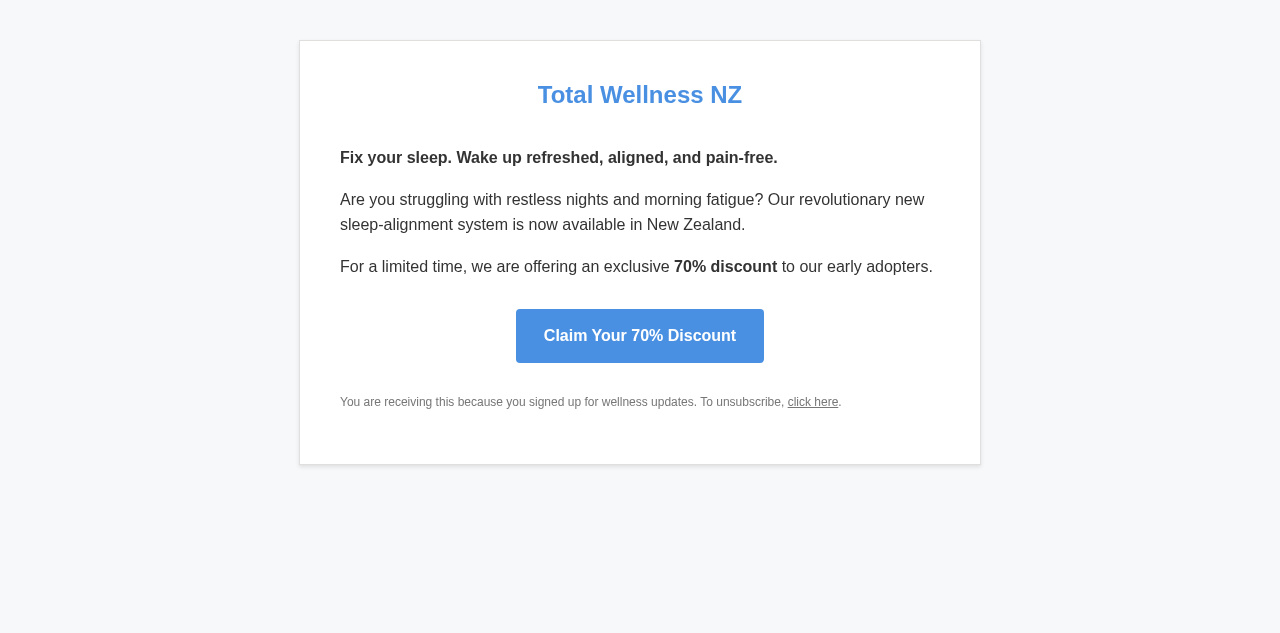
A persistent spam campaign themed around wellness and sleep health has been identified targeting New Zealand inboxes, utilizing lures that promise "alignment and pain-free" sleep. The emails are designed to look like legitimate health product promotions, often featuring professional layouts and attractive discount offers, such as 70% off. By appealing to the common desire for improved physical well-being, the threat actors attempt to drive users toward unauthenticated web domains.
The social engineering premise relies on a high-volume, low-specificity approach. Because wellness is a broad and generally positive topic, these messages are less likely to be immediately flagged as malicious by traditional security filters compared to aggressive financial or legal lures. This "soft" entry point is weaponized to encourage users to click through to landing pages where personal information and credit card details are requested under the guise of an early-adopter promotion.
Technical analysis of the campaign reveals a complete lack of verifiable email authentication. The messages originate from the domain tacline.lat, which fails both SPF and DMARC validation checks. This indicates that the sending infrastructure is either misconfigured or, more likely, a transient domain registered specifically for bulk delivery of unauthenticated content. The destination links often resolve through multiple redirects to obfuscate the final malicious destination from basic link-scanning tools.
Organisations are advised to maintain a high degree of skepticism toward unsolicited wellness or health promotions. Staff awareness should emphasise that legitimate New Zealand health providers will not communicate through unauthenticated international domains or request significant personal data via email links. Suspicious emails should be reported to internal IT teams for domain-level blocking and forwarded to CERT NZ to contribute to national threat intelligence.
The domain the message claims to be from. Fresh registrations and known-bad reputations are the strongest technical tells of a spoofed sender.
Practical steps you or your IT provider can take to reduce the risk from this kind of threat.
• Audit the Sender. Verify the sender domain (tacline.lat). Legitimate NZ wellness brands will not send unauthenticated mail from unrelated TLDs. • Ignore Unsolicited Discounts. Be wary of "70% OFF" lures that create artificial urgency around health products. • Report and Delete. Forward the message to your security team and report it as phishing to CERT NZ (report@phishing.cert.govt.nz).