


How a Fake Spotify Renewal Alert Is Targeting Your Staff
A sophisticated Spotify impersonation campaign using fake billing failure alerts to harvest credit card details.
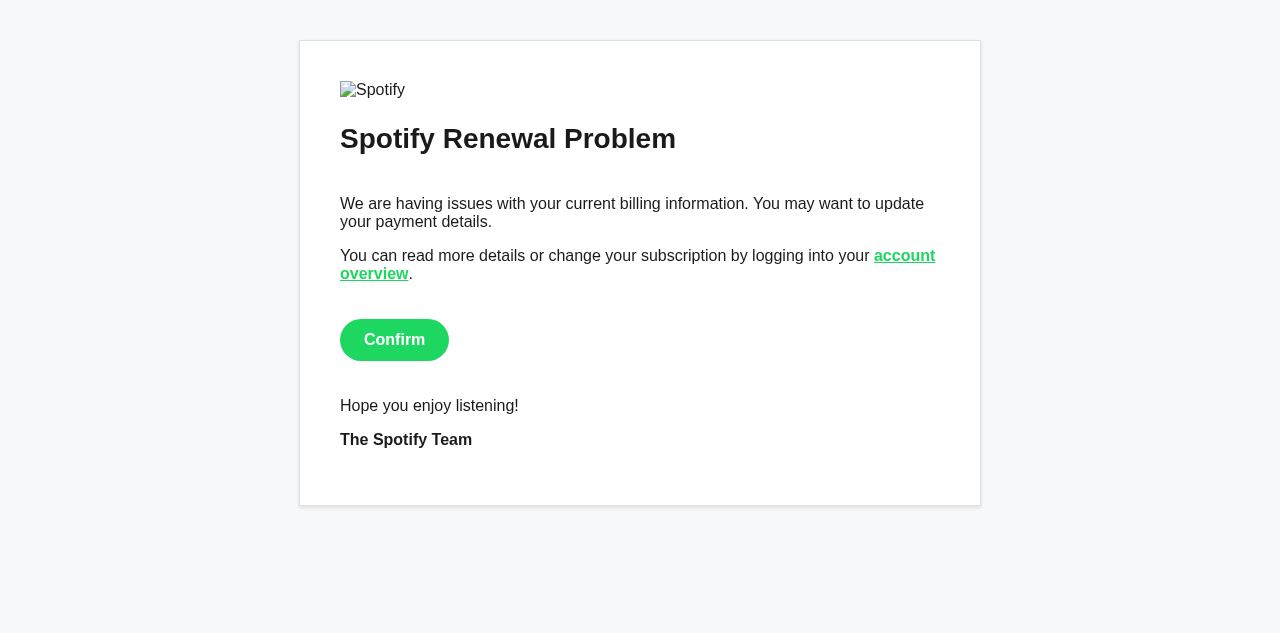
A targeted phishing campaign impersonating Spotify has been identified circulating across New Zealand, utilizing deceptive "Subscription Paused" alerts. The emails attempt to create immediate financial concern by claiming a renewal problem and urging users to update their billing information. By leveraging the high recognition of the Spotify brand, threat actors aim to lower the defensive posture of recipients, prompting them to click a malicious link to a fraudulent account overview page.
The social engineering technique used in this campaign is designed to trigger a routine administrative response. Because streaming services are commonly used across both personal and professional devices, staff members are highly likely to treat a "payment failure" notice as a legitimate task to be resolved quickly. This familiarity is weaponized to drive traffic to a credential-harvesting site, where both login details and credit card information are collected under the guise of account verification.
Technical analysis of the campaign reveals the use of a third-party sender infrastructure, with messages originating from domains like hubspotfree.eu1.hs-send.com. While the campaign utilizes technical authentication features like DKIM and DMARC to bypass basic spam filters, it fails SPF validation, indicating the domain configuration is being abused for unauthorized distribution. The embedded link redirects users through multiple hops before landing on a high-fidelity clone of the Spotify login portal.
Organisations are advised to ensure that billing and account alerts for cloud-based services are handled through official, verified channels. Staff should be instructed to ignore links in unsolicited emails and instead verify account status directly through official applications or by navigating to spotify.com independently. Suspicious messages should be reported to Internal IT and forwarded to CERT NZ to aid in the tracking and blocking of the malicious infrastructure.
The domain the message claims to be from. Fresh registrations and known-bad reputations are the strongest technical tells of a spoofed sender.
Practical steps you or your IT provider can take to reduce the risk from this kind of threat.
• Check the Sender. Always verify the sender address. Official Spotify alerts will only come from @spotify.com addresses. • Use Your Bookmarks. Never click billing links in emails. Log in directly via the official Spotify app or website to manage your account. • Verify Independently. If you receive a payment failure notice, check your bank statement first to see if the transaction actually failed. • Report Phishing. Forward any suspicious billing alerts to your security team or report them as phishing to CERT NZ (report@phishing.cert.govt.nz).
See what a genuine Spotify message looks like, the real sender domain, the real link destination, and where to report a fake.