


What a Fake NZ Post Email Wants You to Hand Over
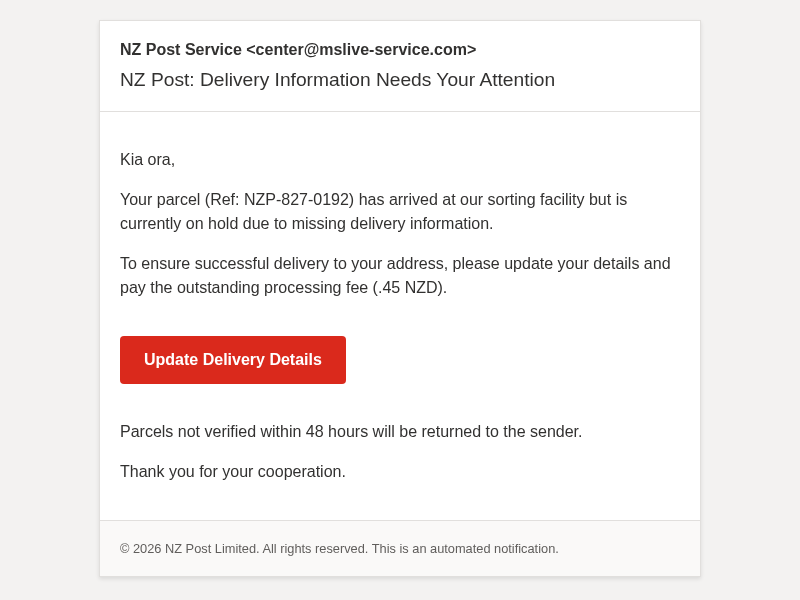
A phishing campaign impersonating NZ Post is currently circulating, with messages originating from the sender domain mslive-service.com — a domain bearing no legitimate affiliation with New Zealand Post Limited or its authorised communications infrastructure. The use of a fabricated sender address structured to superficially suggest a Microsoft-adjacent service is a deliberate social engineering technique, designed to lend a veneer of technical credibility to what is, in practice, a fraudulent communication.
Campaigns of this nature typically follow a well-documented pattern. Recipients are presented with a notification purporting to relate to a parcel delivery issue — a missed delivery, a customs fee, or a shipment hold — accompanied by a link or attachment intended to harvest personal information, payment card details, or account credentials. The timing and framing of such lures are calibrated to provoke an instinctive response, bypassing the recipient's critical evaluation of the message's legitimacy.
Organisations operating in New Zealand should treat this campaign as an active threat to their workforce. Employees who regularly receive logistics and courier notifications as part of their professional responsibilities represent a plausible target demographic. Where staff are accustomed to actioning delivery-related communications with minimal scrutiny, the probability of a successful interaction with a phishing payload is materially elevated. Awareness briefings and updated mail filtering rules referencing the identified sender domain are appropriate defensive measures.
Individuals who have received a message matching this profile should refrain from clicking any embedded links, downloading attachments, or providing any information via forms reached through the email. The message should be reported through the organisation's established incident reporting channel and deleted. NZ Post publishes guidance on identifying fraudulent communications purporting to represent its brand, and verification of any unexpected delivery notification should be conducted directly through the official NZ Post website by navigating there independently.
The domain the message claims to be from. Fresh registrations and known-bad reputations are the strongest technical tells of a spoofed sender.
Practical steps you or your IT provider can take to reduce the risk from this kind of threat.
• Do not click any links or pay fees. NZ Post will never request small "processing fees" via unsolicited emails or texts from unofficial domains.
• Verify through the Official App. Use the official NZ Post app or website (nzpost.co.nz) to check parcel status using your tracking number.
• Report to CERT NZ. Report the incident via their website at cert.govt.nz or by forwarding the email to report@phishing.cert.govt.nz.
• Block the Sender Domain. Ensure mslive-service.com is blocked at the organisational mail gateway level.
See what a genuine NZ Post message looks like, the real sender domain, the real link destination, and where to report a fake.